
How Your Water Heater Leaking Compounds Over Time
A tiny, rhythmic drip in a dark basement, utility closet, or garage is one of the most deceptive sounds a homeowner can encounter. It is easy to dismiss a small puddle as mere condensation or a minor issue that can wait until next weekend's DIY to-do list. Unfortunately, residential water damage is a silent, compounding thief that accelerates with every passing hour.
This comprehensive guide explores the compounding nature of water heater failure. By looking at how a seemingly insignificant leak escalates over days, weeks, and months, we will demonstrate why immediate intervention is the only way to prevent a minor plumbing annoyance from transforming into a full-scale household catastrophe.
Ignoring the Initial Signs of Rust and Corrosion
The lifecycle of a water heater leak almost always begins invisibly. Most modern water heaters are constructed of steel, lined with a thin layer of glass or enamel to prevent the water from directly touching the metal. To further protect the tank, a sacrificial anode rod attracts corrosive elements in the water, rusting away so the tank doesn’t have to.
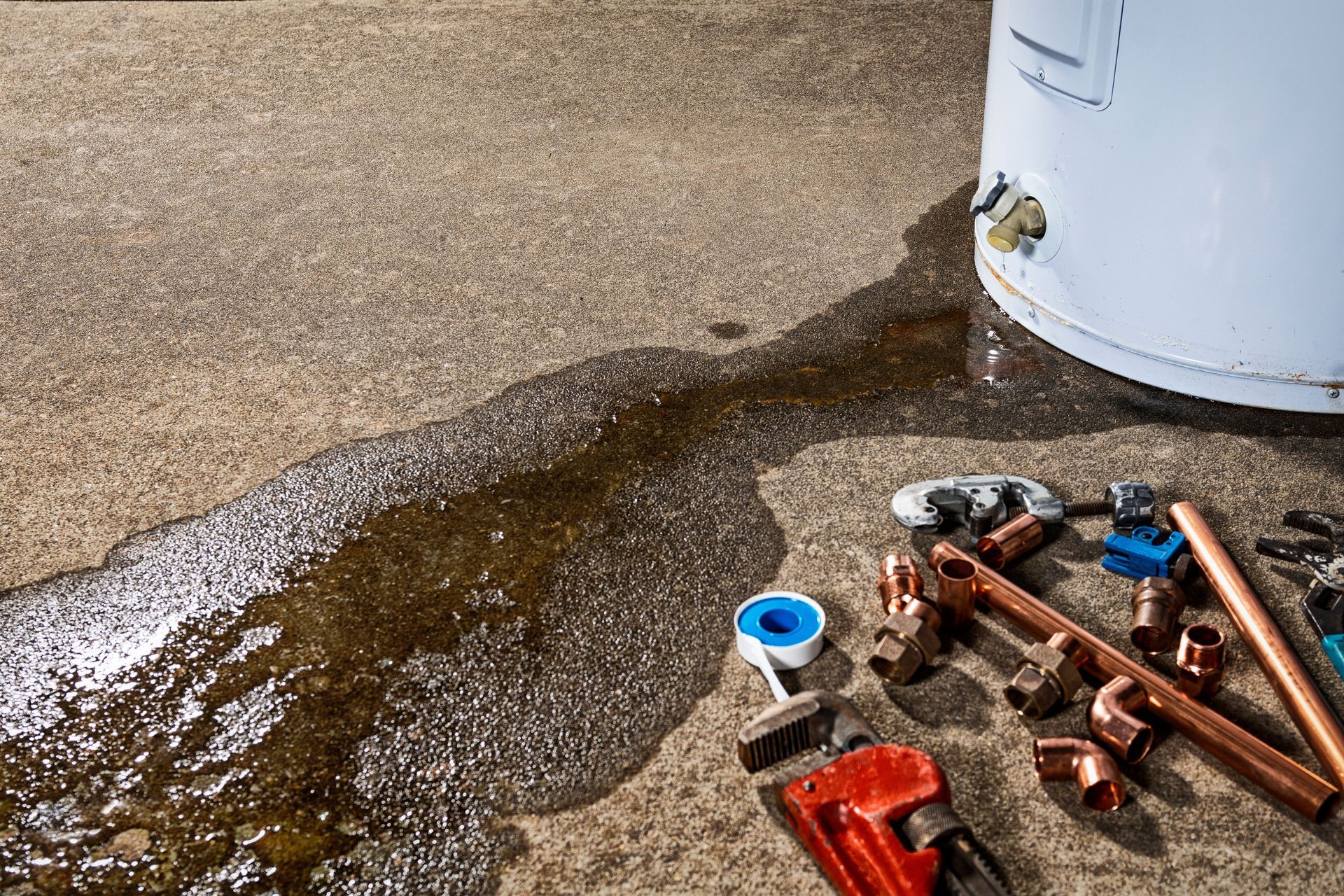
However, anode rods have a limited lifespan. Once the anode rod is fully depleted, the highly corrosive, heated water turns its attention to the tank’s steel shell. Tiny micro-fissures begin to develop, often around welded joints, the base of the tank, or the intake and output valves.
The compounding danger here is chemical oxidation. When water meets iron and oxygen, rust forms. This rust eats away at the surrounding metal, structurally thinning the tank walls. What begins as a microscopic pinhole or a slow dampness around the base quickly accelerates because a water heater leaking creates a corrosive feedback loop that permanently weakens the tank structure. As the metal thins, the internal pressure of the tank pushes outward, causing the tiny hole to expand exponentially over time.
Wasting Thousands of Gallons of Treated Water
It is difficult for the human mind to accurately conceptualize the volume of water lost through a constant, low-volume drip. Our team has found that a leak that drops just once per second can waste thousands of gallons of water in a single year. If that drip turns into a steady, pencil-thin stream, the numbers skyrocket dramatically.
To put domestic water consumption into perspective, we can look at broader usage baselines. According to Plumbing Manufacturers International, a family of four in the U.S. uses an average of 400 gallons of water a day, which is equivalent to double the average amount used by a family in Europe.
When a water heater develops a steady leak, it doesn't operate like a standard faucet that can be turned off; it leaks continuously, 24 hours a day, 7 days a week. A severe, unaddressed leak can easily lose hundreds of gallons of water daily. Homeowners are often shocked by their utility bills, failing to realize that a water heater leaking 24/7 can silently double their monthly water consumption, forcing them to pay for thousands of gallons of treated municipal water that literally flows straight into their floorboards or basement drains.
Escalating Your Monthly Energy and Utility Bills
The financial toll of a leaking water heater is a two-front war. While you are paying the city for the physical volume of wasted water, you are simultaneously paying your energy provider to heat that wasted water.
Water heaters operate on a simple thermal principle: when hot water leaves the tank, cold water enters from the main line to be heated. When a leak occurs, hot water is constantly escaping the system. In response, the thermostat detects a drop in internal temperature, triggering the gas burners or electric heating elements to kick on.
Instead of cycling on a few times a day when your family takes showers or runs the dishwasher, the heating elements must work around the clock to compensate for the continuous loss of thermal energy. This constant cycling drastically spikes gas or electric bills, making a water heater leaking a double hit to your wallet through both wasted water and wasted energy. Over several months, the cumulative cost of this wasted energy can easily equal the price of a brand-new, high-efficiency water heater.
Spawning Dangerous Mold and Mildew Growth
While the structural and financial impacts of a leak are severe, the biological impacts pose a direct threat to your family’s health. Microorganisms like mold and mildew require three basic ingredients to thrive: a dark environment, stagnant air, and a consistent source of moisture. Because water heaters are typically tucked away in poorly ventilated closets, basements, or utility rooms, they provide the ultimate incubator.
As the water continues to pool or seep into surrounding building materials, the mold colony expands. What starts as a small patch of mildew on the drywall behind the tank can quickly transform into a massive colony of toxic black mold. Because utility closets are often located near central HVAC intakes, a water heater leaking provides the perfect, undisturbed breeding ground for toxic black mold to spread undetected, allowing airborne spores to be distributed throughout the entire house and trigger chronic respiratory issues, allergies, and asthma attacks in inhabitants.
Rotting Your Home’s Structural Foundations
Water is an incredibly destructive force when introduced to modern building materials. Most residential homes rely on a framework of wooden studs, plywood subflooring, and gypsum drywall. These materials are highly porous and act like a sponge when exposed to standing water.
When water pools at the base of a water heater, it slowly wicks upward into the drywall and downward into the subfloor. Over weeks of continuous saturation, a process known as dry rot (or wet rot, depending on the fungi present) sets in. The cellulose fibers within the wood break down, causing the wood to soften, swell, and completely lose its structural load-bearing capacity.
If your water heater is located on an upper floor or in a main-level closet, the compounding damage can cause the floorboards to sag, risking a localized structural collapse. The structural remediation costs of a prolonged water heater leaking routinely dwarf the actual cost of simply replacing the plumbing unit itself, as contractors must rip out structural beams, joists, and subfloors to rebuild the framework of the home.
Ruining Personal Property and Stored Belongings
Basements, garages, and utility closets serve a dual purpose in most households: they house major mechanical appliances, and they act as primary storage zones. Homeowners routinely stack cardboard boxes filled with seasonal clothing, holiday decorations, legal documents, and irreplaceable family heirlooms in the very same rooms where their water heaters reside.
Cardboard boxes are incredibly effective at drawing water upward through capillary action. A box sitting three feet away from a leaking tank can absorb water from the bottom up without showing any external dampness on its top or sides. Discovering a water heater leaking often happens too late, usually when a homeowner goes to retrieve irreplaceable photo albums or seasonal items, only to find them ruined by contaminated water, covered in slime, and completely unsalvageable.
A leaky water heater is never a static issue; it is a progressive, compounding problem that worsens with every tick of the clock. What begins as a minor inconvenience that could be solved with a simple valve replacement or a quick service call quickly expands into an expensive nightmare. From skyrocketing utility bills and destroyed personal property to structural rot and toxic mold growth, the true cost of neglect builds exponentially. Don't wait for a small puddle to turn into an indoor swimming pool; if you notice your water heater leaking, taking swift, decisive action is the only way to protect your wallet, your property, and your peace of mind.
If you suspect your water heater is losing efficiency or exhibiting signs of a moisture problem, don't let a small drip turn into a costly disaster. Contact the reliable plumbing experts at Joe Pro Plumbing - Heating - Air today to schedule a comprehensive system inspection and avoid compounding damage. Protect your home and your peace of mind by letting us handle your water heater repair or replacement needs before a minor leak becomes a major flood.
Share On: